
Call +44 (0) 1452 645649
The winter that changed East German football forever
Kit Holden - 4th February 2026
Reform, realpolitik and Cold War rivalry: Why almost every major club from the former GDR celebrated its 60th anniversary in the last few weeks
Temperatures were below freezing in south-east Berlin last Tuesday, and the floodlights were very much off in the Alte Försterei. The next matchday was four days away, and the ground staff were still laying new turf after weeks of ice and snow. Yet the place was buzzing.

BFC Dynamo battle to a 2-0 win over Chemie Leipzig in the GDR Oberliga just months after their official founding in January 1966. Photo: German Federal Archive (Bundesarchiv Bild 183-E0416-0009-001)
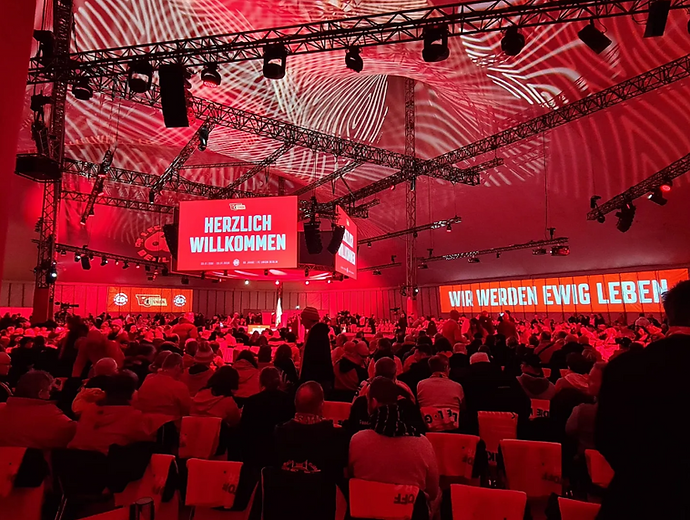
Around 4000 Union fans had braved the cold to attend the club’s 60th anniversary celebrations. In a 30-metre high, glowing red circus tent in the stadium car park, they were treated to a three-hour programme of music, speeches and nostalgia. Those who stuck it out until the end, when the wind chill had dropped to almost minus double figures, were rewarded with free beer.
Union have plenty to celebrate. Two years on from their Champions League adventure, the one-time minnows are still riding a wave of euphoria as one of the fastest-growing clubs in the country. They are now in their seventh successive top-flight season, during which time both their membership and their annual revenues have quadrupled.
They were not the only ones making merry, however. On the same night, 200 kilometres away, 1. FC Lokomotive Leipzig were also marking their 60th in Leipzig’s grand, 19th century train station. Five days earlier, fans of BFC Dynamo and Chemnitzer FC had done the same with midnight displays of fireworks and flares, while the weeks before had seen similar festivites at Rot-Weiß Erfurt, 1. FC Magdeburg and Hansa Rostock. Over the past month, a total of ten clubs from the former GDR have all - in one way or another - turned 60.
This is no coincidence. All of these ten clubs were founded as part of a radical, top-down reform of GDR football in the winter 1965/66. Sparked by the Cold War rivalry between the capitalist West and the communist East, it was a reform which has continued to shape the East German game long after the fall of the Berlin Wall.
In 1965, the GDR was not yet two decades old and still struggling to establish itself on the global stage. It would be another seven years before its statehood was officially (though not fully) recognised by the West, allowing it to join the United Nations. It had built the Berlin Wall just four years previously, effectively imprisoning its own citizens in order to avoid total economic and demographic collapse. Against that backdrop, sport was a way of building legitimacy. It had always been - and would remain - one of the regime’s favourite soft-power instruments.
Yet in football at least, the GDR was still some way off its dream of becoming a major European power. The country had not qualified for a single World Cup since joining FIFA in 1952, and had never got past the last-16 of the new European Championship. It had enjoyed more success at the Olympics, though even that came with a caveat. Until 1964, the two Germanies competed under the same flag at the Olympics, with the football teams disputing an internal play-off to decide which team would be sent to the Games. When a de facto GDR side won bronze in Tokyo, they did so as “The United Team of Germany”. In club football, meanwhile, West Germany was already beginning to pull ahead with the founding of the Bundesliga and professionalisation in 1963. The East, whose clubs had made next to no impression in the emerging European club competitions, was in danger of losing ground.
So, the state embarked on a root-and-branch reform of the football infrastructure. At the heart of it was the founding of ten new Fußballclubs or “FCs” across the various regions of East Germany. These clubs were conceived as a new elite, designed to dominate the domestic game and - more importantly - act as regional development centres to feed the national teams with a steady stream of talent.
Though by no means the first reform of its kind, it was by far the most radical. Whereas previously, all elite football teams had been folded into wider, multi-sport clubs and associations, now the FCs would act as independent entities, directly under the national football and sport authorities. That, in effect, meant a centralisation of political power. Even clubs like Union, whose fans would later be romanticised as football “dissidents”, were now more directly under party control.
“The national sports association DTSB was, like all mass organisations, an extended arm of the party,” said Union’s club chronicler Gerald Karpa in an interview with Der Tagesspiegel. “From 1966 to 1990, Union was therefore an active element of the political system.”
However tied up it was with party ideology, though, the football reform was also an act of cold-blooded Realpolitik: a tacit admission that if the East was going to keep up with its western rivals, it would have to follow their playbook.
When the Allies divided Germany into zones of occupation in 1945, they had initially banned all sports clubs across the country. In the West, the old clubs were soon reintroduced, whereas in the East, the authorities set about creating an entirely new sporting culture along communist lines. “Clubs” with paying members were considered bourgeois, and replaced instead with “workers’ sports associations” (BSGs), which were tied to the new state-owned enterprises of the centralised economy. Players would, in theory, be playing for their workplace and their team would be named accordingly: Chemie for the chemical plants, Lokomotive for the railways, Dynamo for the police.
Kit is a British-German sportswriter. He covers Union Berlin for Der Tagesspiegel newspaper and is the author of two books: "Scheisse! We're Going Up: The Unexpected Rise of Berlin's Rebel Football Club" and "Played in Germany: A Footballing Journey Through a Nation's Soul". He is also the expert guide on our tour - 'Beyond the Wall' where we will discover how the erection of the Berlin Wall had a revolutionary impact on the city's football landscape.