
Call +44 (0) 1452 645649
Hitler at the Poststadion and Berlin's Olympic dilemma
Kit Holden - 18th February 2026
At the end of January, Berlin mayor Kai Wegner fired the starting gun on his city’s bid to host the Olympic Games. In 2026, Berlin will go up against Hamburg, Munich and the Rhine-Ruhr region in a race to be chosen as Germany’s official candidate to host the 2036, 2040 or 2044 Games. Yet for Wegner, the real struggle may be to convince his own electorate.
“Berlin wins with the Olympics” claims the bid’s confident official slogan, unveiled with much pomp at the velodrome last month. But not everyone is so sure. A recent survey by Der Tagesspiegel newspaper showed that around two thirds of Berliners are currently against the bid. As in many other places, the Olympics remain a deeply divisive issue. Unlike elsewhere, the debate in Berlin is not just about grassroots legacy and public spending. It is also about history, and the long shadow of Germany’s Nazi past.
Over the coming months, that debate will not just centre around the city’s major sporting venues like the Olympiastadion, the velodrome and the proposed beach volleyball court at the Brandenburg Gate. It will also be hashed out in the smaller, more forgotten corners of Berlin’s sporting landscape. Places like the Poststadion in the western district of Moabit.
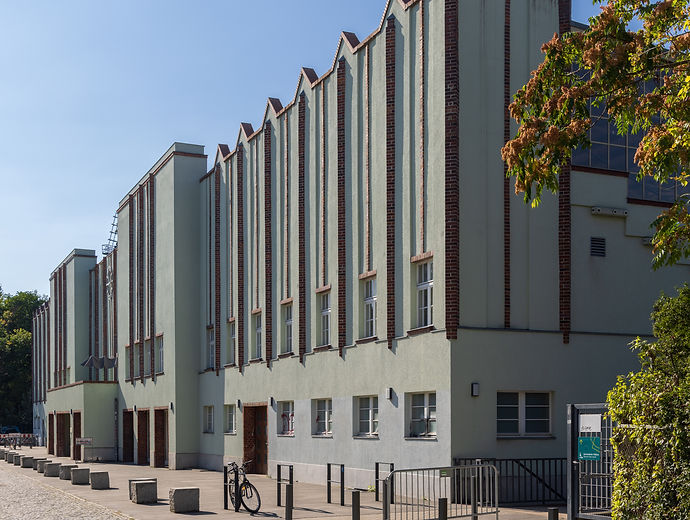
Its elegant 1920s grandstand aside, the Poststadion doesn’t look like much. A small, 10,000 capacity ground on a leafy, residential street near the capital’s modern central station, it has not hosted a major event for decades and it is not among the slated venues for a possible Berlin Games. Yet there are few places that better embody Berlin’s Olympic dilemma. On the one hand, it is proof of the capital’s crumbling sporting infrastructure, its desperate need for an investment boost. On the other hand, it is a reminder that in this town, history always looms large.

A century ago, the Poststadion was one of the most important sporting venues in Berlin. In 1934 and 1936, it hosted the final of the German football championship, then decided via an end-of-season playoff between regional league champions. More famously, it was also a venue at the 1936 Olympic Games, and the site of Adolf Hitler’s only recorded visit to a live football match.
On August 7th 1936, more than 50,000 spectators flocked to the Poststadion to watch Germany take on Norway in the quarter-finals of the Olympic men’s football tournament. Among them were Hitler and other leading Nazis including propaganda chief Joseph Goebbels. The dictator had been to the Poststadion only a few weeks earlier to address a May Day Hitler Youth rally, and now he had returned to watch what most assumed would be a comfortable victory for the hosts.
Yet the Nazis were in for a shock. Having decided to rest key players for the semi-final, coach Otto Nerz watched in horror as his team slumped to a 2-0 defeat against an unexpectedly strong Norway side. “The Führer is very agitated, I can barely contain myself. A real cauldron of nerves. The crowd rages. A fight like never before. The game as mass suggestion” wrote Goebbels in his diary.
However much the emotions of the crowd might have appealed to Goebbels, the result was a disaster for Germany. Football, a chaotic game originally imported from the British bourgeoisie, had always fit poorly into the Nazis highly racialised vision of sport. In “Olympia”, Leni Riefenstahl’s notorious, four-hour propaganda film of the 1936 Games, the football competition merited a mere three minutes of footage. The Norway defeat only damaged its reputation further. Hitler, it is said, had only reluctantly agreed to watch the Norway game at all, having initially wanted to attend the rowing or the polo on the same day. According to one version of the story, he left the stadium in outrage before the final whistle.
It would remain the most famous game ever played at the Poststadion. After his selection misstep, Nerz was quietly sidelined as head coach. His replacement, Sepp Herberger went on to become one of the great heroes of post-war German football, leading West Germany to their first World Cup win in 1954. At the same time the Poststadion’s star faded. Originally built as a major stadium for the national capital, the post-war division of Germany instead left it isolated in a divided city, without a major football club to keep it alive.
It has remained that way ever since, a stadium whose development was, like that of its city, forever stunted by the violence of the 20th century. Nowadays, the biggest club that plays at the Poststadion are fifth-tier minnows Berliner AK 07. Like most clubs of their size, they are happy to have anywhere to play at all. In Berlin, the 40 years of division left a legacy of chronic debt and fragmented sporting culture. Even now, many of the city’s small stadiums are in a state of chronic disrepair, stifled by lack of investment and a tangled bureaucracy.
.jpg)
For those who back the bid, the Olympics are a chance to change direction and breathe new life into Berlin sport. Mayor Wegner and his coalition point to recent renovations at the Poststadion, including reinstallation of floodlights, as a step in the right direction and promise the Olympics would deliver similar effects across the city. Rather than building new white elephants, they say, the bid is based on a renovation of existing facilities “in the interests of all Berliners”.
Yet even if all that is true - and critics remain sceptical about the actual sustainability of the bid - there is also the other elephant in the room. No amount of renovation and investment can paper over the Nazi past and the 1936 Olympics. The fact remains that the last time the Olympics were held in Berlin, Adolf Hitler watched on from the stands. And despite the best efforts of Norway and Jesse Owens, the Games were ultimately a successful propaganda event for a racist, murderous Nazi regime.
For many, it is simply unthinkable that the Games should return to Berlin, least of all in 2036. As former conservative interior minister Horst Seehofer put it in 2019: “How would the rest of the world see that? The Germans are celebrating the 100-year anniversary of the Nazi Olympics? That cannot be.”
Even if Berlin ended up hosting in 2040 or 2044 - which is now more likely - the historical baggage would still weigh heavy. From the vast Olympiastadion to the humble Poststadion, almost every sporting venue in the city bears echoes of tyranny, war and division.
For Wegner and the politicians, the Olympics are a prestige project, a way of projecting Berlin as a global centre on a par with London or Paris. Yet in truth, Berlin is different. Despite its current peace and prosperity, it remains a city defined by its traumatic 20th century. If you ask many Berliners, that is reason enough to say no to the Games.
Kit is a British-German sportswriter. He covers Union Berlin for Der Tagesspiegel newspaper and is the author of two books: "Scheisse! We're Going Up: The Unexpected Rise of Berlin's Rebel Football Club" and "Played in Germany: A Footballing Journey Through a Nation's Soul". He is also the expert guide on our tour - 'Beyond the Wall' where we will discover how the erection of the Berlin Wall had a revolutionary impact on the city's football landscape.